


Three months ago, we made a bet on public interest AI and set out to build and orchestrate the world's most ambitious effort to create a viable public alternative to proprietary AI. We believed the pieces of a public alternative to big AI already existed, scattered across thousands of open source projects, and that the hard part was getting them to work together. That's the idea behind AI Potluck: different groups bring different pieces and build something together that none could build alone.
At the AI for Good Summit in Geneva last July, we launched AI Potluck's first proof of concept: Alpha v0.1. Built entirely from open-source components, Alpha was developed through a collaboration with ten partners, each bringing a piece of the stack. We built it in seven weeks.
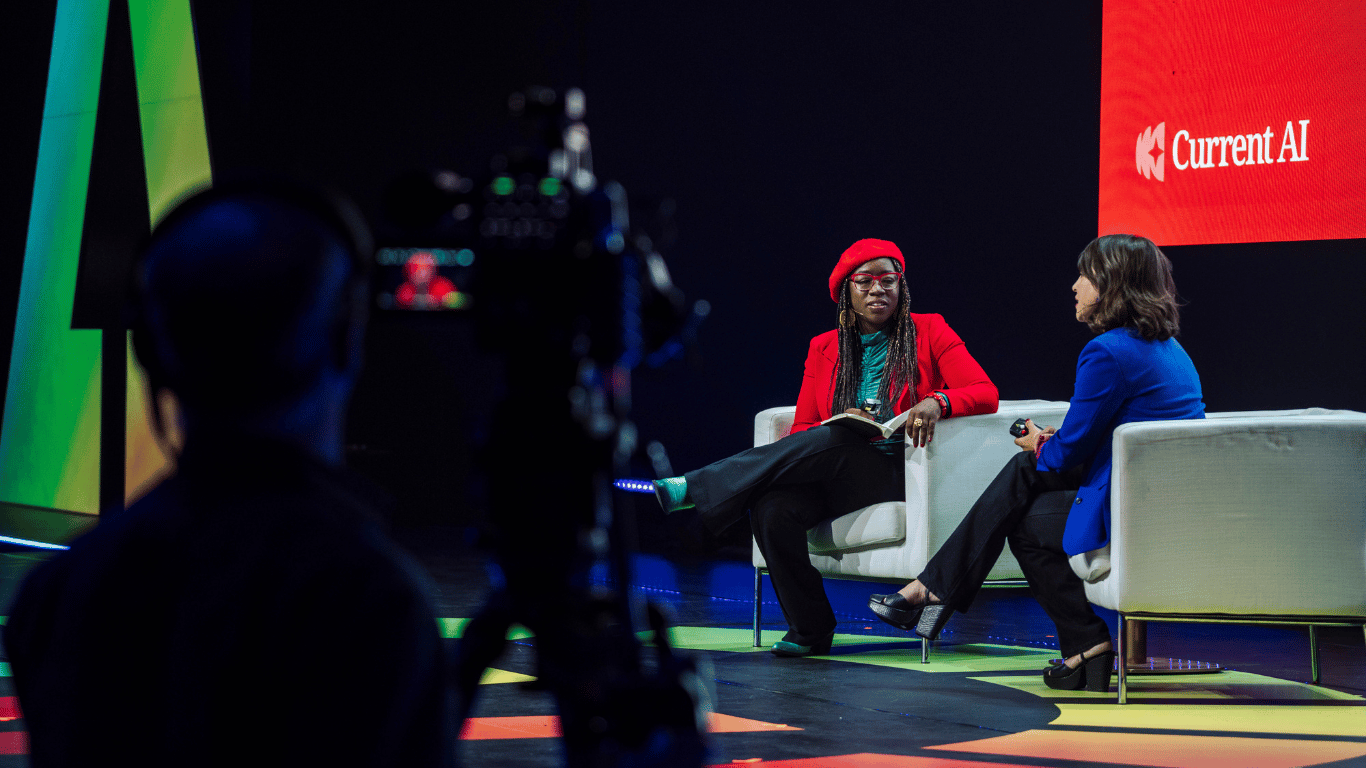
In the three months since Geneva, the Gap Map has more than doubled to more than 60,000 open source AI projects. Our shared table has grown from ten partners in July to 19 today, each bringing something Alpha didn't have then. In July, Alpha ran on a single model. Today, it draws on open models from Switzerland, Spain, Singapore, Poland, France, and beyond, and you get a say in how it works.
Introducing Alpha v0.2
The momentum from the past three months led to a bigger table and an improved Alpha.
At MozFest in Barcelona, we're launching Alpha v0.2. The growing table has changed what Alpha can do, and this release gives people more say in how they use it. Here is what that looks like in practice.
Your language
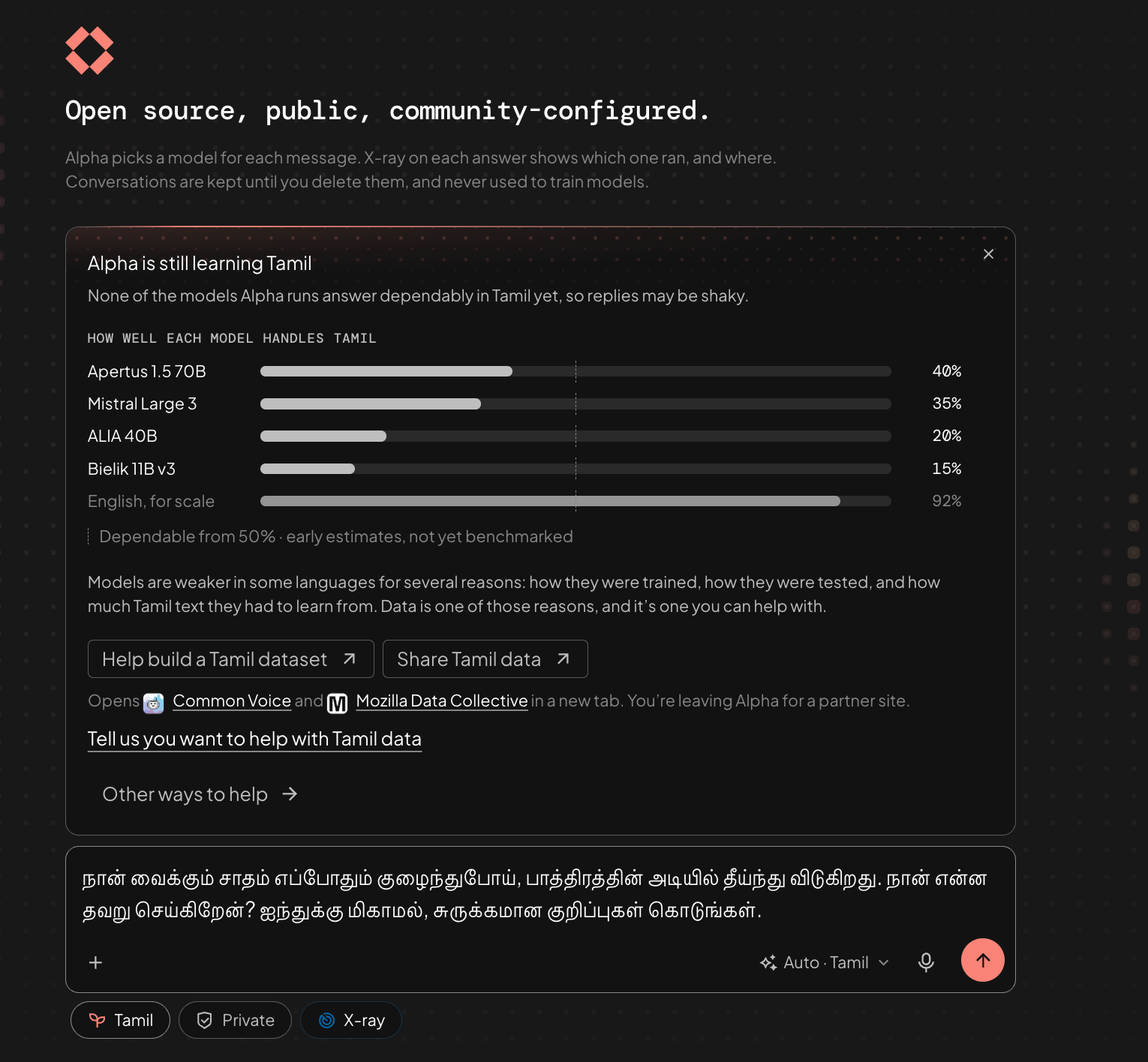
The Collective Intelligence Project tested the models available in Alpha across 122 languages using Belebele, a reading-comprehension benchmark. Those results show how models handle written text in different languages, but reading comprehension alone cannot tell us which model is right for every task. Alpha's model picker uses Clef, an open source decision model from Cloudflare, to consider CIP's results alongside each model's overall proficiency and what you are asking it to do.
A request in Catalan might go to ALIA, built by the Barcelona Supercomputing Center for languages spoken in Spain. A request in Indonesian might go to SEA-LION, developed by AI Singapore with NVIDIA. AI Singapore's language datasets also inform a new category in the Gap Map.
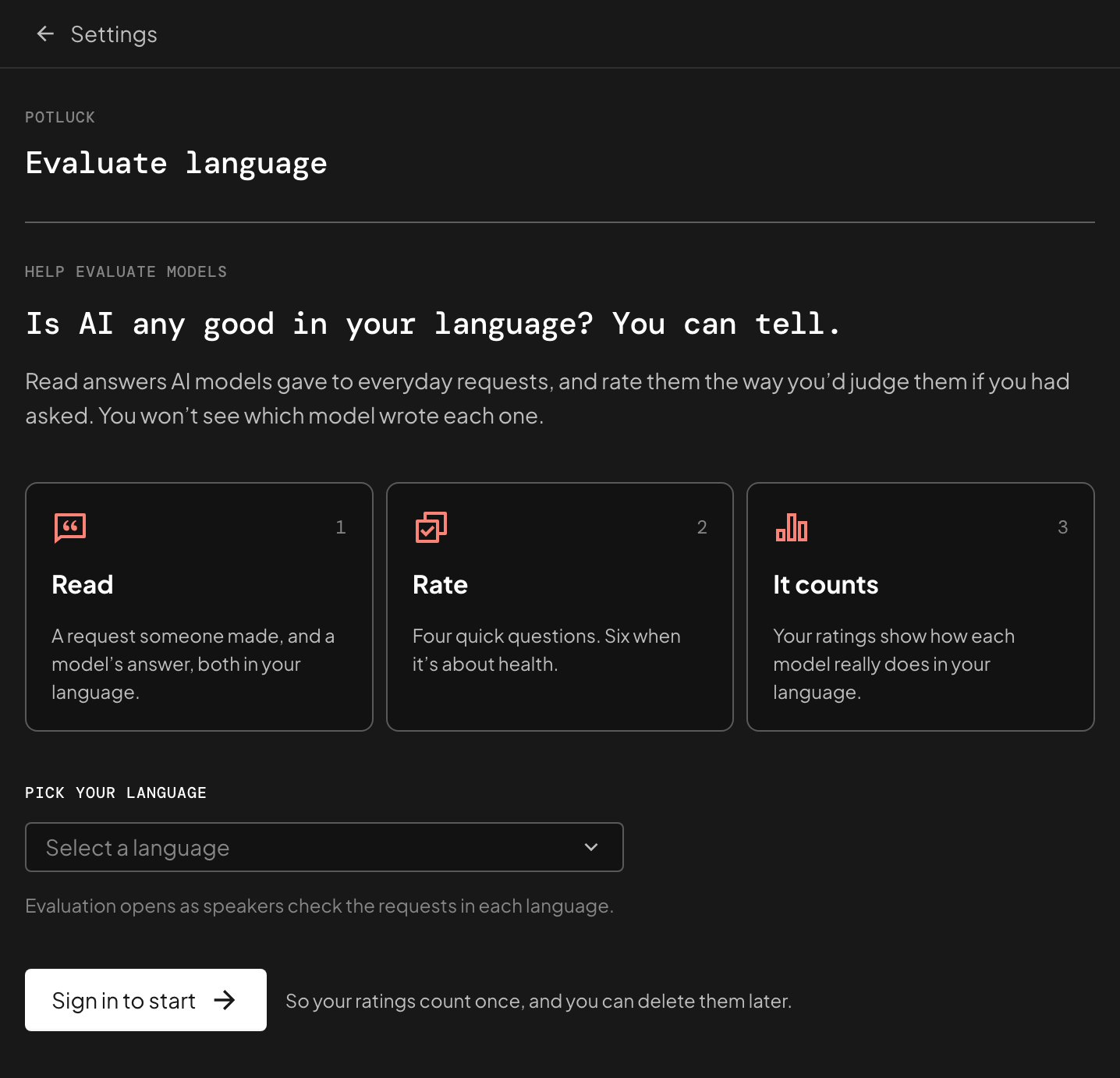
Our partner Taraaz contributed an in-app language evaluation tool, with questions adapted from the Multilingual AI Safety Evaluation Lab. Roya Pakzad developed the lab during her Mozilla Foundation fellowship to evaluate how AI answers change across languages. In Alpha, you can use the tool to rate anonymized model responses across Italian, Portuguese and French languages, with many more to come.
When the available models struggle with your language, Alpha tells you and points you toward ways to help: contribute your voice to Common Voice, share a dataset through the Mozilla Data Collective, or rate answers using a method from Taraaz adapted from the Multilingual AI Safety Evaluation Lab that Roya Pakzad developed during her Mozilla Foundation fellowship.
Your language shouldn't decide whether AI can help with the work you need to do, and when available models fall short, you should have a way to change that.
Your data
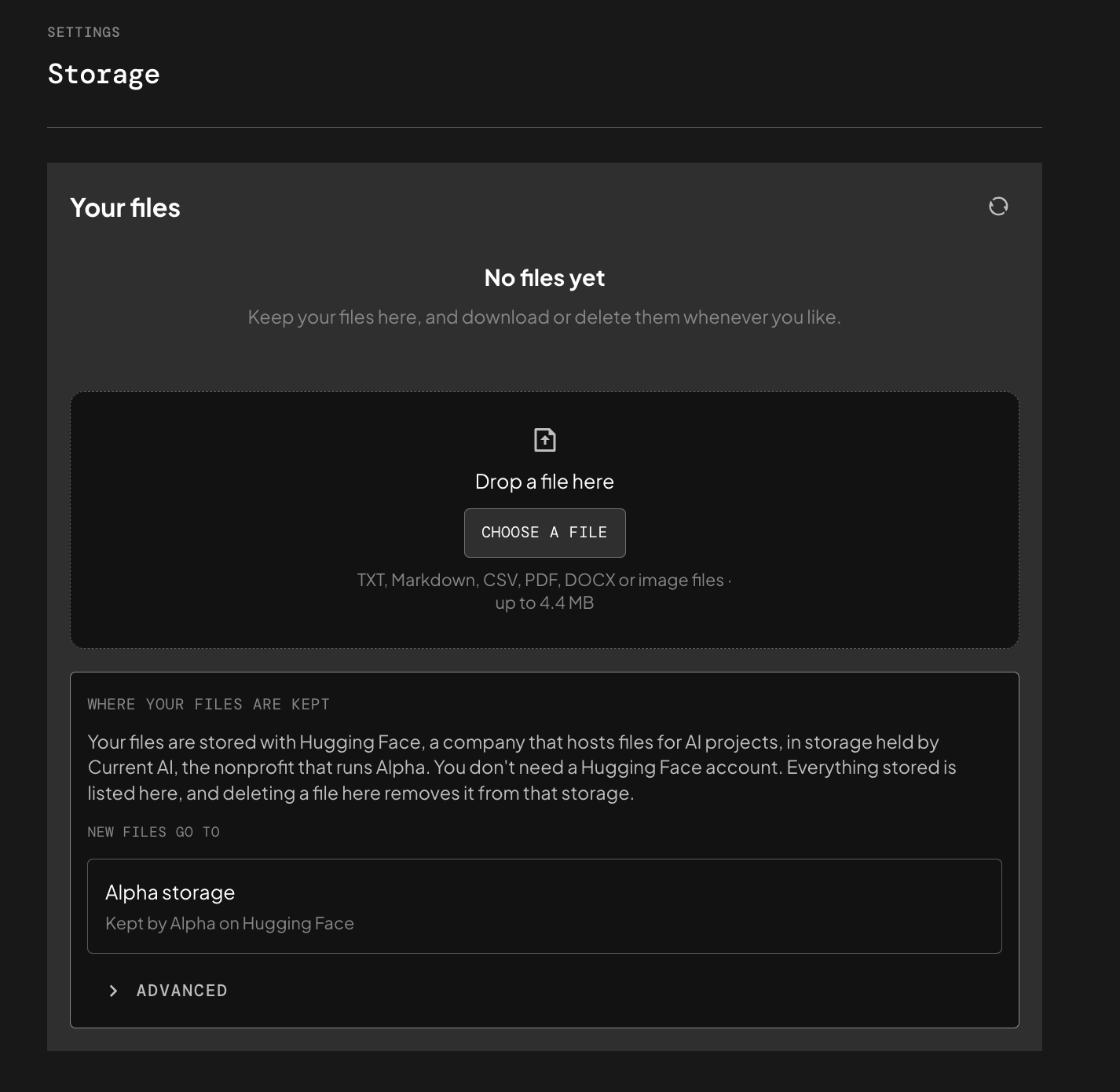
Alpha shows you what data it keeps and where it's held. When you sign in, Alpha stores your files in a Hugging Face bucket. You can also connect your own Hugging Face bucket instead. Alpha makes it easy to export all your conversations and files, delete anything you've stored, or erase everything while keeping your account. We don't train AI on your conversations.
Your rules
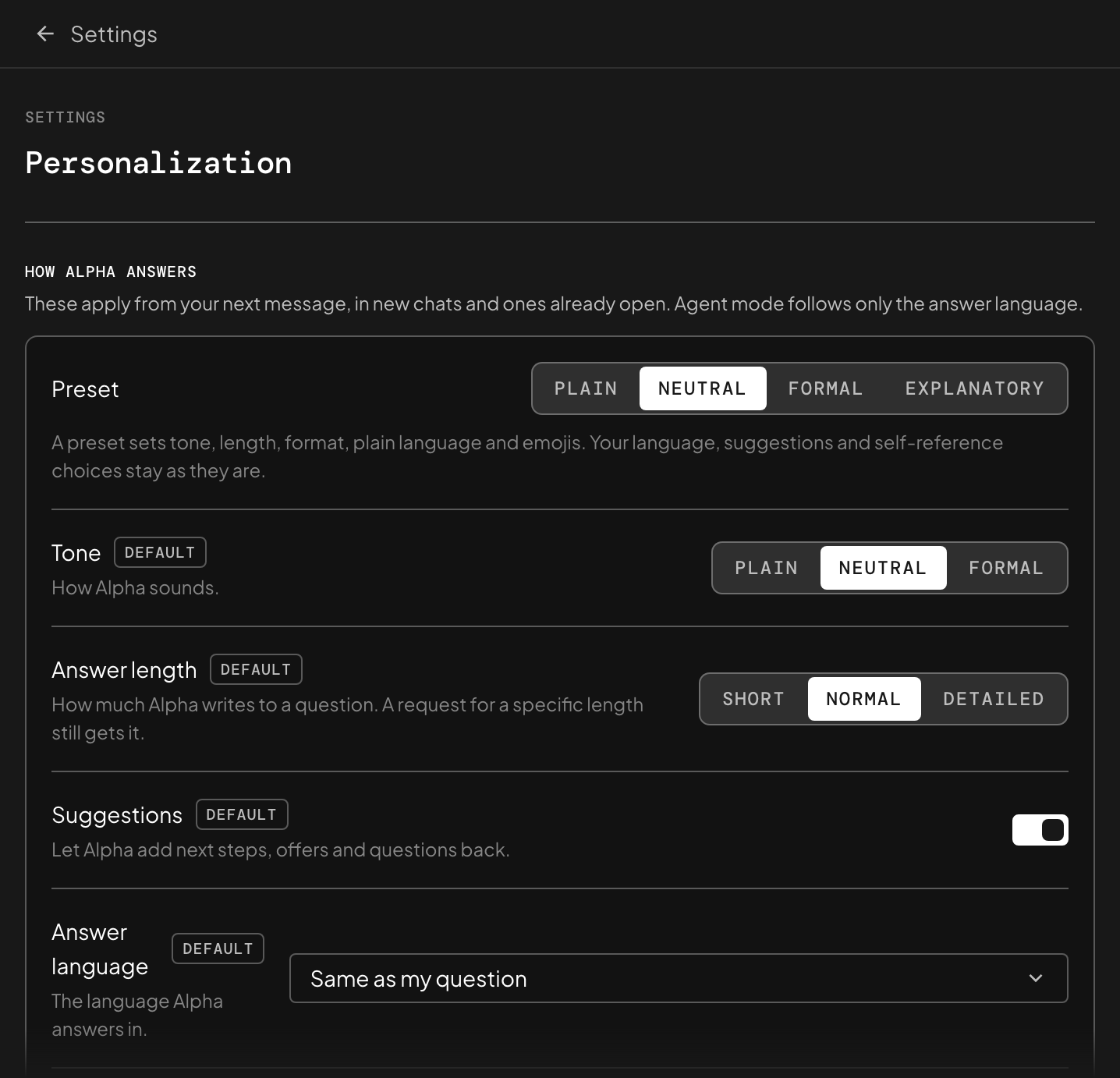
You decide how Alpha answers you, from its tone and length to what it calls itself, and your instructions follow you into every conversation, whichever model is answering. You can also choose which open model answers you or let Alpha choose for each question.
What comes next
Alpha v0.2 is the third milestone in a 12-month sprint to build a public option for AI. At FOSDEM in January 2027, Alpha v0.3, "Make AI Ours," is planned as a version teams and communities can test, fork, modify, and deploy safely. UNDP has joined as a design research partner, bringing insights from its Local Language Accelerators and AI Landscape Assessments across 11 countries to the work on community use.
In April 2027, Alpha v0.4, "Make AI Work," will focus on building and designing with people beyond a chat. The June 2027 target is an Alpha v1.0 release candidate for adoption across the public interest ecosystem. The public roadmap is a shared plan for the build: it shows what partners are contributing and where others can join. No single organization can build a public alternative alone, and what Alpha becomes depends on who joins and what they bring.
Bring something to the table
Alpha v0.2 isn't a finished product. It's a working model, built in public, that shows what this approach can already do and where it still needs work. Try Alpha in your language, then tell us what works, where it falls short, and what would make it yours. What you tell us will help shape what we build next.
Builders. Bring a model, dataset, benchmark, safety tool, or compute. The Gap Map shows what is already being built and where work is still needed.
Communities. Bring people together to test Alpha in the languages and settings that matter to you. Show us where it falls short, and help shape what comes next.
Funders. Fund a missing piece of the shared roadmap or contribute resources that help others build.
Governments. Bring public resources, including compute, data, or models, to the shared build.
At MozFest?
Join the Gap Map Jam on Thursday, October 29, 2026, at 10:00 am, or our research session at the Open Source House Developer Stage on Friday, October 30, 2026, at 10:00 am. See the full schedule.
We're building and shipping every month. Subscribe to our newsletter and stay on top of our release notes and all AI Potluck updates.