

By nature, all AI systems are opaque and multidimensional. They become even more complex when thousands of developers from all over the world contribute unique projects over 13+ layers. This is the current state of the open source AI stack: seriously robust, but fragmented, duplicative, and hard to see as a coherent whole.
Introducing Current AI’s Open Source Gap Map: a living, actionable visualization of AI’s open source landscape.
The Gap Map comes out of cumulative work to identify the points of highest leverage in the open source AI stack: where to build something new, where to invest in capability, where to open up the tools. By creating an up-to-date visualization of the ecosystem where we can all see both the progress and the gaps in the space, we hope to rally the community around a collective roadmap.
Today, thanks to a handful of amazing designers and data scientists (and a lot of startup hustle), we’re sharing the v0.1 of the Open Source AI Gap Map.
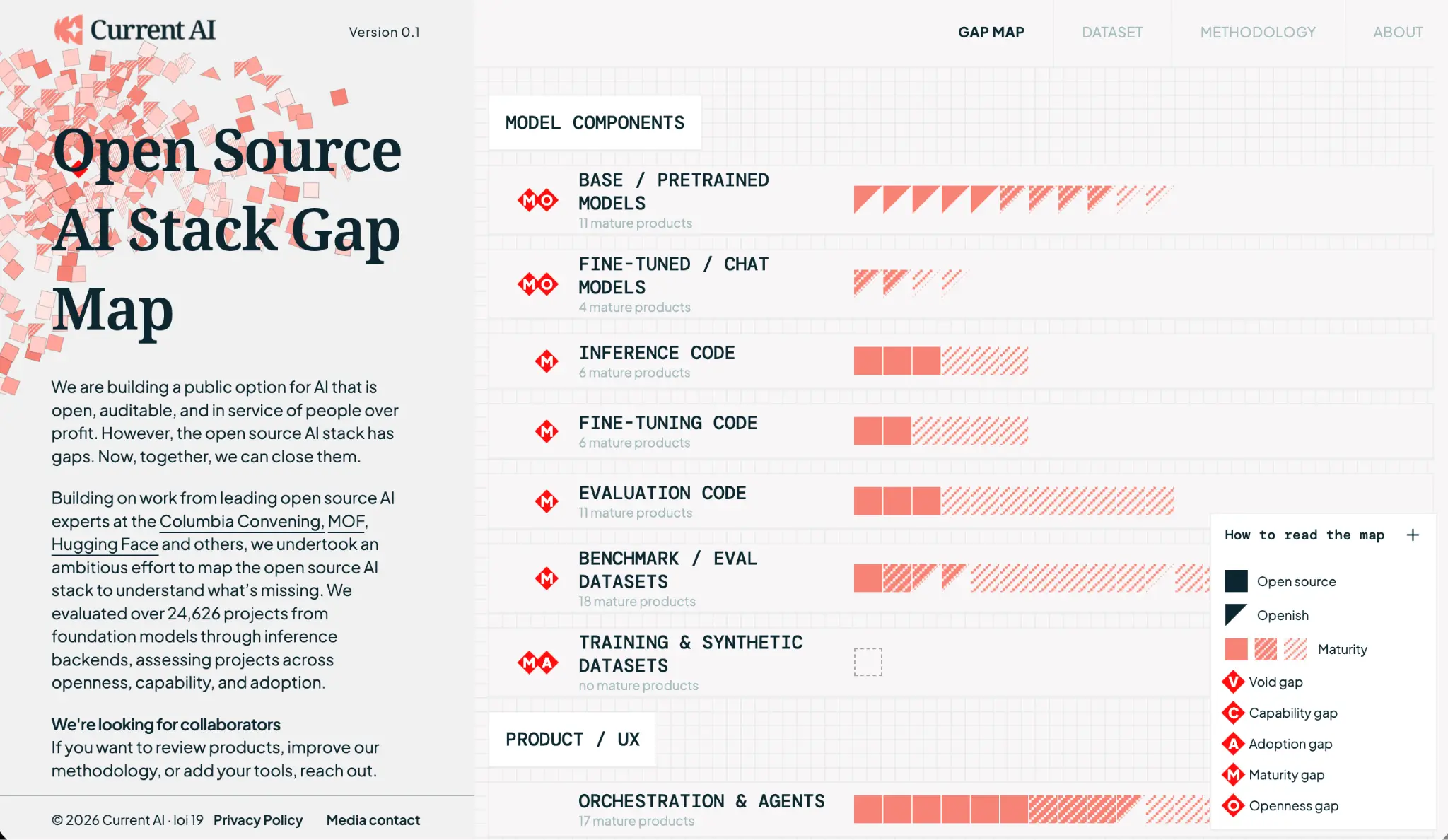
The Gap Map surveys over 24,600 projects to show what technical components exist now, their state of maturity, and where builders are needed to fill critical gaps in the open source AI stack.
Over time, the Gap Map should answer:
- What projects exist across the various layers of the stack?
- What layers are overinvested in, or underfunded?
- Where are open source options lagging because of adoption, maturity, or capability?
- And, most importantly: What building blocks are missing for creating completely open source AI products?
From Map to Roadmap
All over the world, entrepreneurs, funders, governments, and designers are frustrated with proprietary AI, and are clamoring for an alternative. Some are looking to save money for their startups, others call it AI resilience, and many want sovereignty in the AI stack. We believe the solution lies in an open and public-interest AI stack. The Gap Map is a first of a series of tools Current AI will invest in to help make this complex environment legible. If we see the gaps, we can prioritize them, and then we can collectively direct energy and funding to closing them. That’s how we believe we get to an open AI alternative.
Methodology
To create this first version of the Gap Map, we used both a discovery step to identify projects within the ecosystem (from leading open source AI experts at the Columbia Convening, MOF, and Hugging Face), and a more rigorous scoring and enrichment step to grade each product.
We identified and evaluated over 24,600 projects from foundation models through inference backends, assessing projects across openness (how open is it?), capability (how good is it?), and adoption (how used is it?). The taxonomy we use to categorize products descends directly from the 2024 Columbia Convening on Openness in AI.
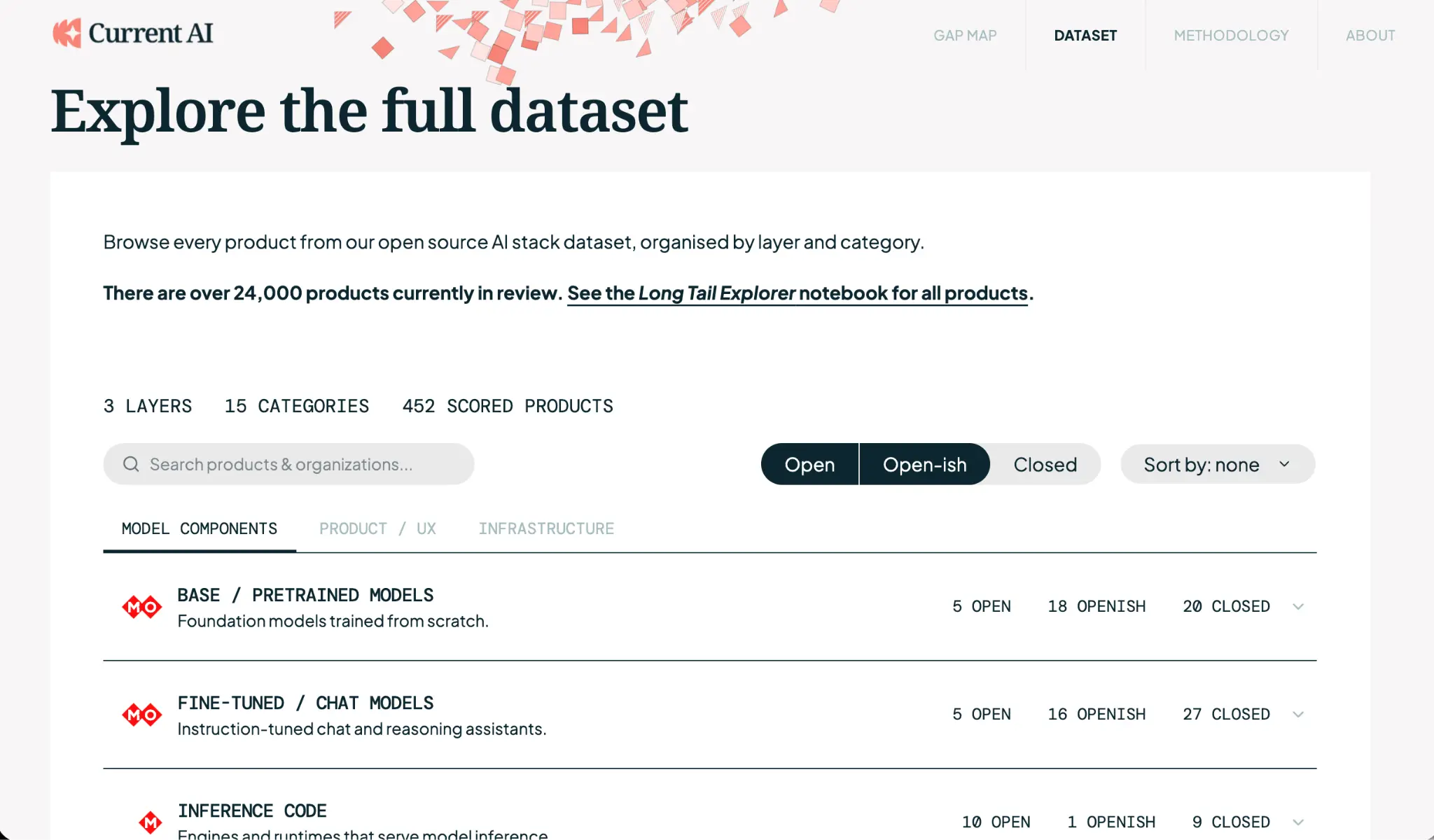
The Gap Map v0.1 details 421 products in depth: 266 software tools and libraries, 85 models, 50 datasets, and 20 hardware projects, produced by 228 organizations. These products are organized into 14 categories across 3 layers of the stack (model components, product / UX, and infrastructure). The remaining 24,400 artifacts constitute the uncategorized long tail of the open source AI ecosystem, and will carry no score until they are researched and cited.
Note that within the Gap Map, we intentionally don’t compare closed versus open AI ecosystems, or point to where open source AI leads or lags. Instead, the Gap Map illustrates what’s needed to build the system we want.
Learn more about our methodology here.
Early Findings
So far, the most interesting findings have emerged where our three axes (openness, capability, and adoption) disagree: the widely-used model that is barely open, or the fully-open projects which few have adopted.
Other early insights include:
- Open source isn't chasing the frontier. Entire capability categories (orchestration agents among them) were first developed in the open source ecosystem, not by frontier labs. The open source AI economy is actually out-innovating the closed one.
- Contribution patterns are also striking. This isn't a network of free riders drawing from a common well. Instead, contributors are actively building shared tooling infrastructure, which signals a level of ecosystem health that's easy to underestimate.
- Health and resilience aren't the same thing. Take inference code, for example. vLLM, llama.cpp, and SGLang are mature, well-adopted, and genuinely open. But there are only a handful of them. Capable, yes. Redundant, not yet. Engineers call this the bus factor: the whole inference layer depends on a handful of projects staying good. This is a common structural vulnerability we see across the stack that public investment is positioned to close.
In the coming weeks, we'll keep pulling more signals like this from the map: what's mature and just needs a marketing push, or where the clearest and most pressing gaps are that the ecosystem can rally around.
How to use the Gap Map
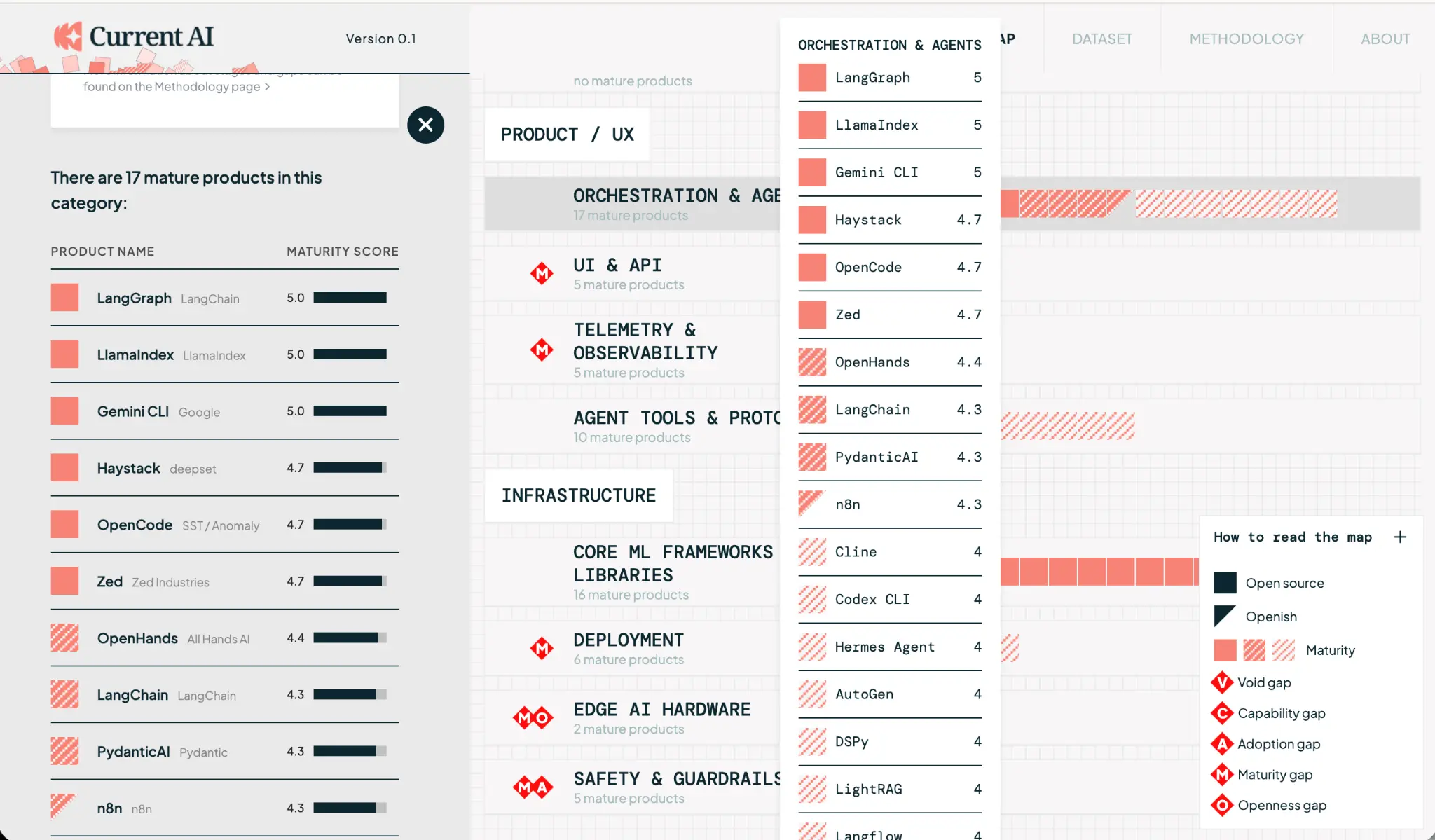
- Interact with the Gap Map at map.currentai.org. Click through it to explore the ecosystem.
- Take a look at some of the notebooks we built exploring different aspects of the data set.
- Want to start working with the data yourself? Go to our GitHub; everything is open source.
Design-wise, we’ve tried to strike the right balance between making it easy to understand (to funders, policymakers, designers, and business people), while also rigorous enough to satisfy the needs of developers and OS AI builders.
We’re looking for collaborators
The Gap Map is an invitation for greater collaboration and coordination across the space, and this is the first step of a public, iterative effort. Early users across the open source AI community have already pointed us toward improvements, and you'll see those folded into the next iteration. Moving forward, we will continue publishing updates and improvements to the map, and we welcome your feedback, support, and insights. Want to be an editor, or to add your tool? Have an improvement to suggest an improvement? Get in touch!